about
For children and teenagers facing long-term hospital stays, the days blur into routine — treatments, rules, waiting. Nest. is an immersive alternative to that monotony: a product concept that carves out a private, controllable retreat inside the clinical everyday. It came out of the "Playful Healthcare" module at Hochschule München, built by a team of three. Research and ideation were collective; prototyping was split up individually, and my focus was on the visual identity and shaping the user experience during interaction.
The question we set ourselves was pointed: how do you let a young cancer patient step away from their illness and everything that comes with it — the pain, the rules, the routines — on their own terms? From early on, we knew the answer had to be both physical and digital, something that could push back against the isolation these kids feel. Expert interviews, including with the KlinikClowns, surfaced the real gaps. Beyond the lack of social contact and the separation from loved ones, what's missing most in the clinical day isn't medical care — it's a sense of autonomy and self-efficacy. Kids have things to do, but almost no say over any of it.
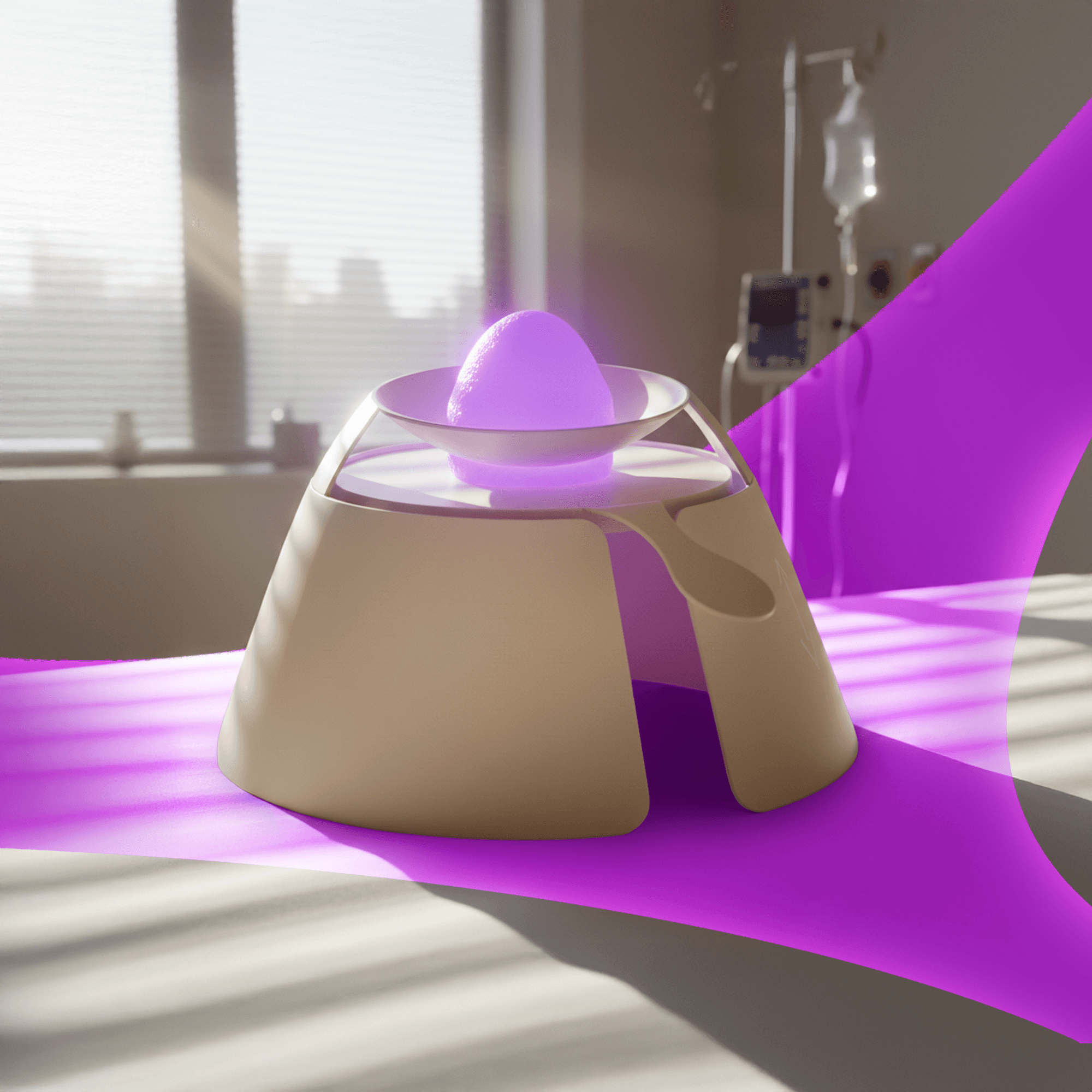
Nest. is a tent-like canopy that extends over the hospital bed, a projection-and-sound environment the patient shapes and controls themselves. When it unfurls, it becomes a private safe space where the child — not the schedule, not the staff — decides what fills it. The name carries the idea: it's the resting place for the "egg," the projection screen wrapped around the bed, and, more than that, a word for shelter and feeling at ease.
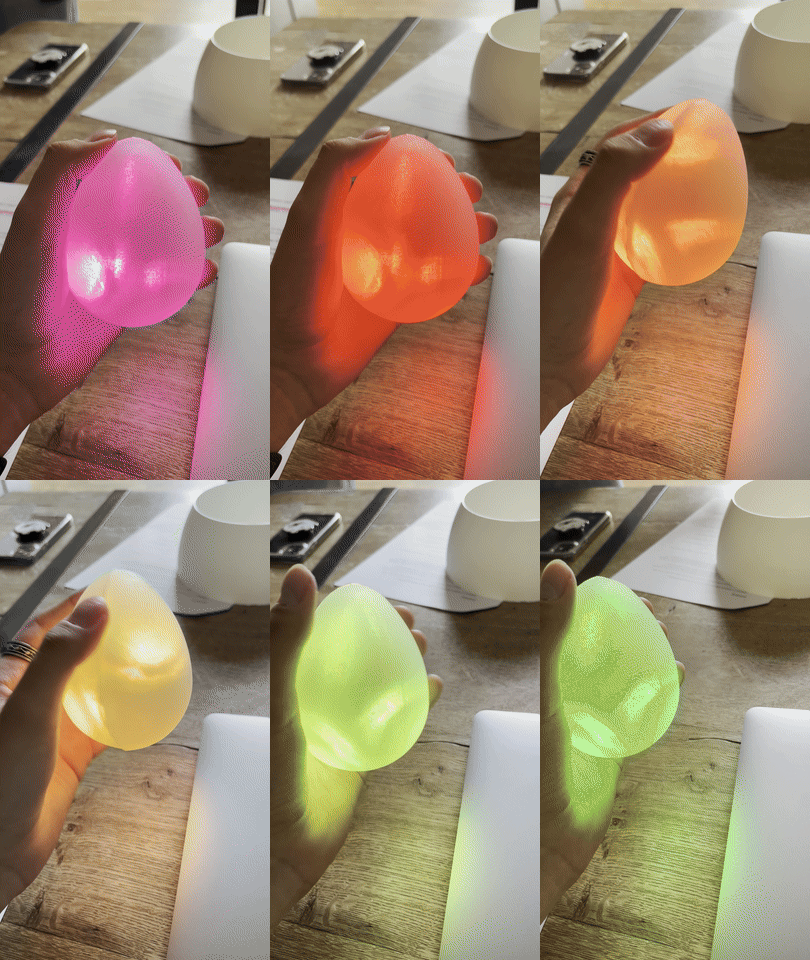
The interaction runs through the egg, an intuitive controller that lifts out of its nest. Everything is deliberately playful and tactile: shake it to switch modes, squeeze it to change color, no menus to learn. In speak mode, it becomes an emotional companion — the child talks to it about their day, their feelings, their wishes, the way they would with a good friend, and those inputs shape what gets projected. In draw mode, the egg turns into a pen for drawing across any surface, from the canopy to the blanket. And a favorites mode lets them save the projections they love and return to them later. Pull the lever, take out the egg, configure a scene, set it back, and the experience begins; when a sequence ends, the child can rate it to tune future content or simply let the system close out quietly.
At its core, Nest. isn't really about the technology — it's about handing back control. To patients who fight their illness every day and live inside strict routines, it offers a small but real space to follow their own wishes, on their own terms. That's the thing the hospital can't easily give them, and it's exactly what we set out to return.
credits
Product Design:
Daryna Darepa
CAD & Product Design:
Juna Han