about
Nearly a century after the Nazi dictatorship, right-wing ideologies are on the rise again in Germany — and the people who lived through the first time find it especially hard to watch history rhyme. That warning, voiced by a Holocaust survivor, is the emotional and thematic anchor of this project. Verharren oder Verändern? — to remain, or to change? — is a bachelor's thesis that refuses to treat that question as abstract. The goal was to translate the underlying causes of these tendencies into a form you can walk through, an installation that confronts visitors directly and forces them to examine their own stance and their own responsibility, here and now. It sets out to do more than inform; it wants to make the mechanism physically felt.
The work began with research rather than design — a study of sociological and historical sources on right-wing tendencies across the last 150 years, filtered down to the most decisive causes. Those findings crystallized into four themes that structure the whole experience: identity, social disintegration, group-focused enmity, and memory and remembrance. From an initial instinct toward straightforward education, the concept evolved into something sharper: deliberate deception. Instead of describing how these mechanisms work, the installation applies them directly to the visitor, so the phenomenon is experienced from the inside.
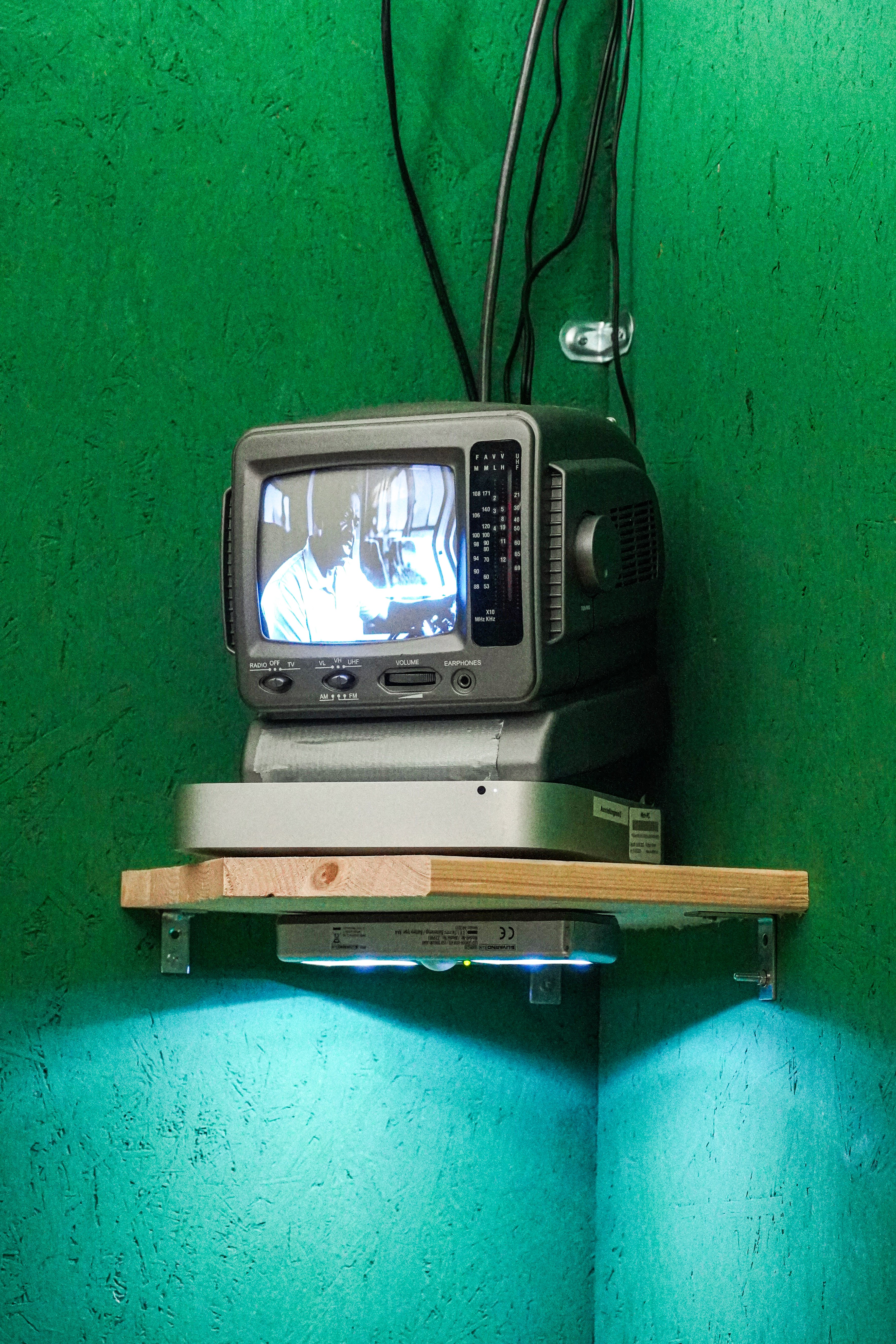
Practically, it's a sequence of connected voting booths. In each, the visitor meets statements that seem harmless but are manipulatively framed — the reasoning patterns of right-wing populism dressed in reasonable clothes. Agreeing leaves a stamp on your ballot. The five booths each dramatize one of the themes: identity through immersive pro-European messaging that hides nationalist rhetoric behind a respectable context; social disintegration through mirrors and an unreachable box of money that provokes a sense of inadequacy and a merit-based hardening; group-focused enmity through a space split into "us" and "them," warmth on one side, dehumanizing headlines on the other; and memory through a time capsule of nostalgic audio — real and synthetic interviews blurred together — that flatters the past until the evidence undercuts it. The manipulation is the message, delivered by making you complicit in it.
Only in the final booth does the illusion break. A large projection of portraits of marginalized people meets your gaze as you stamp, underscored by whispered accounts of real incidents, and you exit physically through the projection surface — a symbolic act of division that makes the consequences of your accumulated agreements suddenly literal. What follows is the "Walk of Shame": an analytical debrief of each booth, a reckoning with your own susceptibility, and a pointer to the theory beneath it all. The stamps overlaid on the ballot form a swastika whose completeness tracks how often you agreed — a symbol chosen deliberately for its shock and its unambiguous meaning, to make the cost of being led visible on the page in your own hand.
What the installation surfaced in practice was as telling as its design. Some visitors deliberately refused the final stamp; others, jolted by the shock, went back and re-evaluated everything they'd just accepted. And in a pointed irony, it was often the visitors with the shortest attention spans who proved most susceptible to exactly the kind of simplification the piece is warning against — a quiet confirmation that the mechanism it dramatizes is very much still at work.
credits